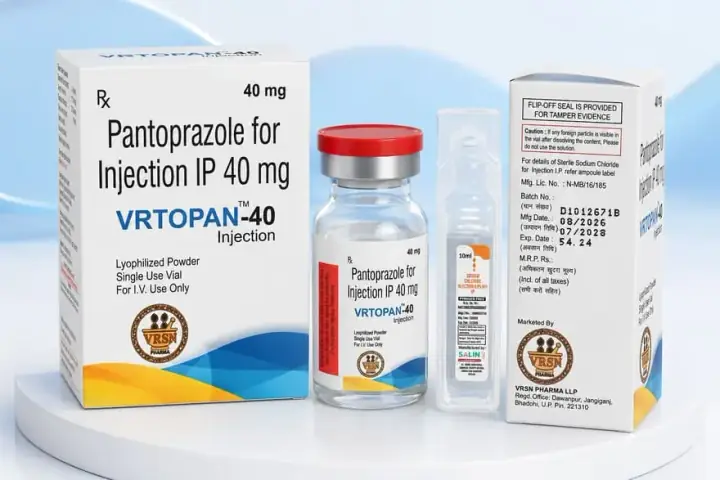
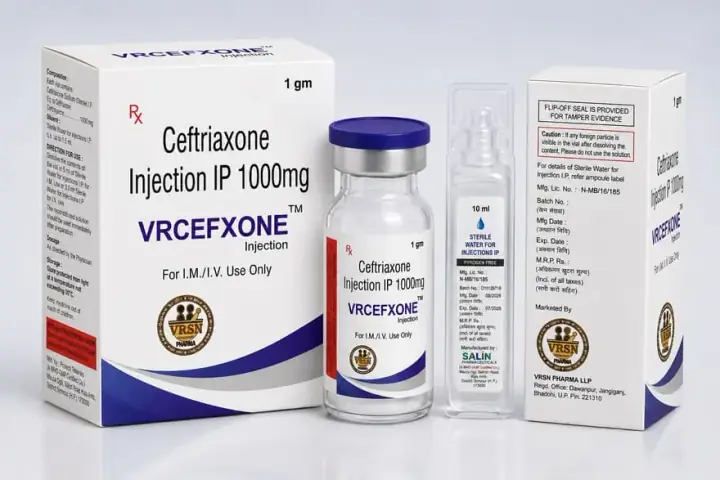
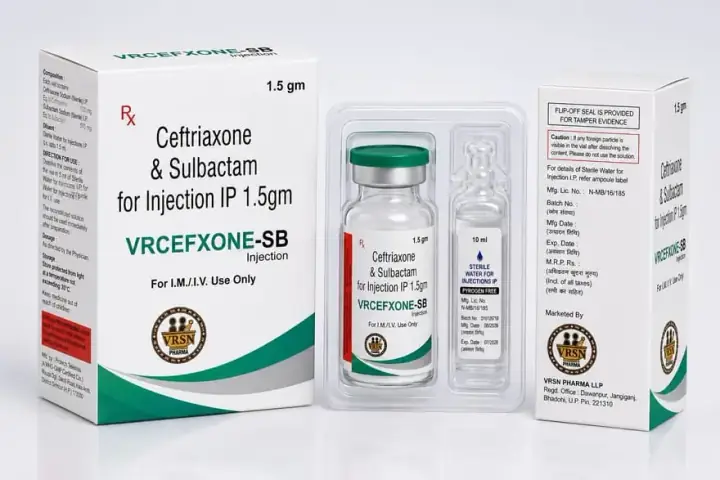
WHO-GMP Manufactured. Independently Tested. Supplied in Bulk.
VRSN Pharma LLP markets and supplies injectable formulations — manufactured by WHO-GMP certified partners and independently tested by NABL-accredited laboratories — to healthcare professionals, distributors and business partners. Starting with Pantoprazole Injection IP 40mg, Ceftriaxone Injection IP 1gm and Ceftriaxone & Sulbactam Injection IP 1.5gm, with new formulations releasing on a rolling basis.
All three formulations are manufactured to Indian Pharmacopoeia (IP) standard, stored below 25°C and protected from light. A Certificate of Analysis is available with every batch.
Additional bulk injectable formulations are in the pipeline and will be added to this catalog on a rolling basis.
Why Procurement Teams Choose VRSN
Built for Buyers Who Can't Afford Inconsistency
Bulk procurement runs on predictability — in documentation, in quality, and in delivery. Here's how we hold that line.
Two-Step Quality Assurance
Every product is manufactured by a WHO-GMP certified partner and independently tested by an NABL-accredited laboratory before it reaches you.
Documentation You Can Verify
WHO-GMP certification and independent test reports from our manufacturing and testing partners, shared on request.
Flexible Bulk Packaging
Vial counts and carton sizes configured to your order volume, coordinated through our manufacturing partners.
Pan-India Logistics
Reliable dispatch to hospitals, distributors and business partners across India.
A Dedicated Account Contact
One point of contact from enquiry to dispatch — no ticket queues, no re-explaining your order.
Responsive Quote Turnaround
Pricing and documentation move quickly, so your procurement timeline doesn't stall on paperwork.
How Bulk Orders Move
From Enquiry to Dispatch
01
Enquiry
Share your product, quantity and location through our RFQ form or WhatsApp.
02
Quote & Documentation
Receive pricing, MOQ terms and relevant WHO-GMP / test certificates for review.
03
Sample & Approval
Request samples for internal QC before committing to a bulk order.
04
Order & Production Slot
Confirm quantities and delivery timeline; your order is scheduled with our manufacturing partner.
05
Dispatch & Tracking
Tested stock is packed and dispatched with full documentation.
Our Quality Framework
Two-Step Quality Assurance
Every VRSN Pharma product carries two verifiable checkpoints before it reaches a buyer.
Step 01
WHO-GMP Certified Manufacturing
Our products are manufactured through WHO-GMP certified manufacturing partners, following established manufacturing and quality-control practices.
Step 02
Independent Quality Testing
Finished products are subjected to relevant quality testing through an independent NABL-accredited laboratory, wherever applicable, to verify specified quality parameters.
Through this Two-Step Quality Assurance Approach, we aim to strengthen confidence in the quality, consistency and reliability of our pharmaceutical products.
Consistent batches, order after order
Audit-ready documentation on request
Fewer supply surprises
From the Blog
Insights for Procurement & Quality Teams
Notes on certification, compliance and what to verify before you commit to a bulk supplier.
Questions, Answered
Frequently Asked Questions
Three formulations are currently available: VRTOPAN™-40 (Pantoprazole Injection IP 40mg), VRCEFXONE™ (Ceftriaxone Injection IP 1gm) and VRCEFXONE™-SB (Ceftriaxone & Sulbactam Injection IP 1.5gm). Additional formulations are in the pipeline and will be added on a rolling basis.
MOQ varies by formulation and packaging configuration. Share your requirement through the enquiry form and we'll confirm the applicable MOQ for your order.
Timelines depend on order volume, packaging and current production scheduling with our manufacturing partner. We confirm a firm dispatch date at the time of order confirmation.
Yes. Samples are available for internal quality checks or regulatory filing before you commit to a bulk quantity.
Yes — a batch-specific CoA is made available with every order, alongside WHO-GMP and independent test documentation on request.
Payment terms are discussed and confirmed as part of the quotation process, based on order size and relationship.
About VRSN Pharma
A Pharmaceutical Marketing & Distribution Company Built on Verifiable Quality
VRSN Pharma LLP is committed to providing quality-focused, reliable and affordable pharmaceutical products — working with WHO-GMP certified manufacturing partners and NABL-accredited independent testing laboratories, starting with Pantoprazole Injection IP, Ceftriaxone Injection IP & Ceftriaxone & Sulbactam Injection IP.
Established 06 January 2026·LLPIN ACU-0122·Dawanpur, Jangiganj, Bhadohi, Uttar Pradesh – 221310
VRSN Pharma LLP is a pharmaceutical marketing and distribution company committed to providing quality-focused, reliable and affordable pharmaceutical products.
We work with WHO-GMP certified pharmaceutical manufacturing partners to ensure that our products are manufactured under established quality systems and applicable pharmaceutical standards.
Our Quality Framework
Two-Step Quality Assurance
Step 01
WHO-GMP Certified Manufacturing
Our products are manufactured through WHO-GMP certified manufacturing partners, following established manufacturing and quality-control practices.
Step 02
Independent Quality Testing
Finished products are subjected to relevant quality testing through an independent NABL-accredited laboratory, wherever applicable, to verify specified quality parameters.
Through this Two-Step Quality Assurance Approach, we aim to strengthen confidence in the quality, consistency and reliability of our pharmaceutical products.
At VRSN Pharma, we believe that healthcare products require quality, transparency and responsibility. We are committed to building long-term relationships with healthcare professionals, distributors and business partners while continuously expanding our pharmaceutical product portfolio.
Our Vision
To build a trusted pharmaceutical company recognized for quality, reliability and responsible healthcare solutions.
Our Mission
To provide quality-focused pharmaceutical products.
To work with WHO-GMP certified manufacturing partners.
To follow a robust Two-Step Quality Assurance Approach.
To ensure appropriate independent quality testing of finished products.
To build long-term trust with healthcare professionals, distributors and business partners.
Leadership
The Team Behind VRSN Pharma
Abhinav Dubey
Director
Anurag Dwivedi
Managing Director
Sandeep Pandey
Director
Gulam Husain Niyazi
Director
Questions, Answered
About & Partnership FAQ
No — VRSN Pharma LLP is a pharmaceutical marketing and distribution company. We work with WHO-GMP certified manufacturing partners who handle production, while we manage quality oversight, documentation and supply.
We share WHO-GMP certification references and NABL-accredited test reports directly with buyers during procurement due diligence.
Yes — we're actively building long-term relationships with distributors and business partners. Reach out through the contact form with a short introduction.
Share your location along with your requirement and we'll confirm feasibility and lead time for your area.
Use the enquiry form on this site, or reach out directly — every enquiry is reviewed by our sales team, not a call centre.
The VRSN Pharma Blog
Insights for Procurement & Quality Teams
Reference notes on certification, compliance and what to verify before you commit to a bulk pharmaceutical supplier.
As we add formulations, we'll publish reference notes and certification updates alongside them. Have a specific question for your procurement team? Ask us directly.
Tell us the formulation, quantity and location — we'll respond with pricing, MOQ and the documentation your procurement team needs.
Response from a dedicated account contact
WHO-GMP & quality-test documentation shared on request
Flexible MOQs for institutional orders
Sample dispatch available before bulk commitment
Quality & Compliance
8 min read
Understanding WHO-GMP Certification: What Bulk Buyers Should Verify
Almost every pharmaceutical supplier will tell you their products are "WHO-GMP certified." For a procurement or quality team placing a bulk order, that phrase should be a starting point for questions, not the end of them. Here's what the certification actually covers, what it doesn't, and the specific documents worth asking for.
What WHO-GMP Actually Certifies
WHO Good Manufacturing Practice guidelines set requirements for the facility, equipment, personnel training, documentation and quality-control systems used to manufacture a pharmaceutical product. In India, WHO-GMP compliance is assessed by the State Licensing Authority in coordination with CDSCO, and a certificate is typically valid for three years from the date of issue.
A WHO-GMP certificate from an Indian manufacturer carries real weight in international procurement, particularly across Africa, Southeast Asia, Latin America and the Middle East. But read the scope carefully: it certifies the process and the environment, not any individual batch. That distinction shapes everything you should ask for next.
Schedule M: India's Own GMP Baseline — And Why It Just Got Stricter
Alongside WHO-GMP, every pharmaceutical manufacturer in India must comply with Schedule M of the Drugs and Cosmetics Act, 1940, enforced by the Central Drugs Standard Control Organisation (CDSCO). Schedule M is not optional and not export-specific — it is the domestic floor.
That floor was raised substantially. The Government of India notified a revised Schedule M on 28 December 2023, significantly expanding GMP requirements for plant, equipment and quality systems. The compliance timeline was staged by manufacturer size:
Large manufacturers (turnover above ₹250 crore) had to comply from 28 June 2024
Small and medium manufacturers were given a longer runway, subsequently extended to 31 December 2025 for those who applied to CDSCO under notification G.S.R. 127(E) dated 11 February 2025
The upgrades the revision demands are substantial and capital-intensive: cleanroom qualification, HVAC validation, purified water and Water for Injection system qualification, computerised system validation, equipment qualification (IQ/OQ/PQ), stability storage capacity, and a documentation overhaul.
For a buyer, this is useful signal. A manufacturing partner that has already completed its revised Schedule M upgrade has demonstrably invested in exactly the systems that keep sterile injectable quality consistent from batch to batch. It is a fair and specific question to ask.
COPP: The Document Export Buyers Actually Need
If your order crosses a border, WHO-GMP alone often isn't the document your importing authority wants. The Certificate of Pharmaceutical Product (COPP) is issued by the national regulatory authority of the exporting country in the WHO-recommended format, and it confirms three things at once: that the product is approved for sale in the country of manufacture, that it is manufactured in a GMP-compliant facility, and that it meets quality standards for export.
Two practical points: a COPP is product-specific, not facility-wide, and it is typically valid for around two years — shorter than the WHO-GMP certificate it sits alongside. In India both are filed through the CDSCO online portal, so a legitimate supplier can retrieve them without difficulty.
What To Actually Request From a Supplier
A copy of the current WHO-GMP certificate, including its issuing authority, scope and validity period
The specific manufacturing license covering the dosage form and molecule you're ordering — a facility's WHO-GMP status doesn't automatically extend to every product category, and sterile injectables are a category of their own
Confirmation of revised Schedule M compliance status for the manufacturing site
A batch-specific Certificate of Analysis (CoA) for the lot you're actually receiving
A product-specific COPP where the order is for export or import registration
Independent test reports, where the supplier operates third-party testing in addition to in-house QC
Why Independent Testing Still Matters
A manufacturing certification tells you the process was built correctly. It doesn't independently confirm that a specific batch met specification — that's a separate, testing-side question. This is precisely why pairing WHO-GMP certified manufacturing with independent, third-party testing closes a gap that manufacturing certification alone leaves open. One checkpoint validates the process; the other validates the output.
A Simple Red Flag
If a supplier is reluctant to share certificate copies, license numbers or batch CoAs before you've placed an order, treat that as information. Documentation should be part of the sales conversation, not something you have to fight for after the fact.
At VRSN Pharma, every formulation we supply is built on two separate, verifiable checkpoints — not one. We call it our Two-Step Quality Assurance Approach, and it's worth explaining why we structured it this way rather than relying on a single certification, as much of the market does.
Step One: WHO-GMP Certified Manufacturing
Our products are manufactured through WHO-GMP certified manufacturing partners, following established manufacturing and quality-control practices. This step controls everything that has to be right before a single vial is filled: facility design and cleanroom classification, HVAC and water systems, equipment qualification, personnel training, batch documentation, and in-process quality control.
For sterile injectables specifically, this is where the hardest engineering sits. A lyophilised powder for injection has no margin for a contaminated fill environment or an unqualified water system — which is why we treat a partner's certification scope, and its revised Schedule M readiness, as a selection criterion rather than a formality.
Step Two: Independent Quality Testing
Finished products are then subjected to relevant quality testing through an independent NABL-accredited laboratory, wherever applicable, to verify specified quality parameters.
The word "independent" is doing real work in that sentence. NABL — the National Accreditation Board for Testing and Calibration Laboratories — is India's national accreditation body, and it assesses laboratories against ISO/IEC 17025:2017, the international standard for testing and calibration competence. Accreditation is not a one-time badge: NABL assessors verify compliance clause by clause, and laboratories are reassessed periodically to keep it.
Two consequences matter for a buyer:
An accredited laboratory's report reflects independently assessed technical competence, traceability and measurement reliability — not a supplier's own assertion about its own product
Reports issued under the NABL accreditation symbol are recognised under the ILAC Mutual Recognition Arrangement in over 100 countries, and NABL accreditation is recognised by CDSCO, BIS, FSSAI and other Indian regulatory bodies
Testing conducted by the same organisation that manufactured the product answers a narrower question than testing conducted by an accredited laboratory with no commercial stake in the result.
Why Both Steps, Rather Than Either One
Manufacturing certification alone tells a buyer that a facility is capable of producing a compliant product. It doesn't independently confirm that a specific batch actually did. Independent testing alone, without certified manufacturing behind it, verifies an output without any assurance that the process producing it is controlled and repeatable.
Run together, they answer two different questions — was this built right? and did this batch come out right? — and neither answer substitutes for the other.
What This Means On Your Purchase Order
In practical terms, a buyer working with us can ask for, and expect to receive, the manufacturing partner's WHO-GMP certificate and license scope, a batch-specific Certificate of Analysis, and independent test documentation where applicable — before committing to a bulk quantity. We also dispatch samples ahead of bulk commitment so your own QC team can run its checks independently of ours.
That's the confidence we're aiming to build with every formulation we add to the catalog — across VRTOPAN™, VRCEFXONE™ and VRCEFXONE™-SB today, and carried forward as our product range grows.
References
NABL India — National Accreditation Board for Testing and Calibration Laboratories
ISO/IEC 17025:2017 — General requirements for the competence of testing and calibration laboratories
Ceftriaxone Injection IP: A Quick Reference for Procurement Teams
Note: This is a procurement and handling reference, not clinical or prescribing guidance. For dosing, administration and clinical decisions, refer to the approved package insert for the specific product and to your clinical team.
Ceftriaxone is one of the more widely stocked injectable antibiotics in institutional formularies worldwide. If it's moving through your purchase orders, here's the background that tends to matter on the procurement side — form, packaging, storage and the questions worth putting to a supplier.
What It Is
Ceftriaxone is a third-generation cephalosporin antibiotic, typically supplied as Ceftriaxone Sodium IP — a sterile powder reconstituted before administration rather than a ready-to-use liquid. Its broad-spectrum profile is a large part of why it remains a formulary staple across hospitals and institutional buyers.
Why the Sulbactam Combination Exists
You'll frequently see ceftriaxone offered both on its own and combined with sulbactam. The reason is resistance.
Some bacteria produce beta-lactamase enzymes that break down beta-lactam antibiotics — ceftriaxone among them — before the drug can act. Sulbactam is a beta-lactamase inhibitor: it irreversibly inhibits those enzymes, protecting the ceftriaxone molecule and extending its useful spectrum against beta-lactamase-producing strains. Sulbactam contributes little antibacterial activity of its own; its job is to keep the partner antibiotic viable.
In India, the ceftriaxone + sulbactam combination has been approved by the Drug Controller General of India (DCGI) for use against ESBL-producing Gram-negative organisms. Given the scale of antimicrobial resistance pressure in Indian institutional settings, many formularies now stock both presentations deliberately rather than treating the combination as a straight substitute.
In our catalog that maps to VRCEFXONE™ (Ceftriaxone 1000 mg per vial) and VRCEFXONE™-SB (Ceftriaxone & Sulbactam 1.5 gm per vial).
Form & Packaging Considerations
Supplied as a sterile powder for injection (IV/IM use) — not a ready-to-use liquid, which changes storage, handling and on-ward preparation requirements
Commonly packaged as single vials, multi-vial cartons, or configured to bulk carton sizes for institutional orders
Strength is specified per vial — 1000 mg (1 g) for the standalone formulation, 1.5 gm for the ceftriaxone & sulbactam combination
Many presentations ship with a matched diluent ampoule (Sterile Water for Injection IP or Sodium Chloride Injection IP) in the same carton — confirm whether your quoted price includes it
Storage & Handling
As a sterile powder, ceftriaxone generally has more forgiving storage requirements than liquid formulations. Typical label conditions are storage at controlled room temperature — commonly stated as below 25 °C or 20–25 °C depending on the market — protected from light, with an unopened shelf life in the region of three years.
Two handling points that are worth flagging to receiving and pharmacy teams, because they are frequently missed:
Post-reconstitution stability is short. Published product characteristics commonly demonstrate in-use chemical and physical stability of around 24 hours at 25 °C, or up to four days at 2–8 °C. Reconstituted vials are not indefinitely storable.
Calcium-containing diluents are incompatible. Ringer's and Hartmann's solutions should not be used to reconstitute or further dilute ceftriaxone, as particulate formation can result.
Exact conditions vary by manufacturer and market, so always confirm against the approved package insert for the specific product you are buying rather than a general reference like this one.
What To Ask a Supplier
Confirmation of Indian Pharmacopoeia (IP) compliance for the specific strength and pack size you need
A batch-specific Certificate of Analysis for the lot being supplied
The manufacturing partner's WHO-GMP status for sterile injectables specifically, not just for the facility in general
Remaining shelf life at the point of dispatch — not just the total shelf life from manufacture
Whether the diluent ampoule is included in the pack and in the quoted price
Realistic lead time from order confirmation to dispatch at your required quantity
If you're evaluating VRCEFXONE™ or VRCEFXONE™-SB for a bulk or institutional order, our product range has the full specification for each pack, or you can go straight to a quote request.